Mount Allison University Random Stuff Software Publications Instruments Policies Links Images SEM WebCam News DMF Home

DMF Developed Software: WFM (Waveform Monitor)
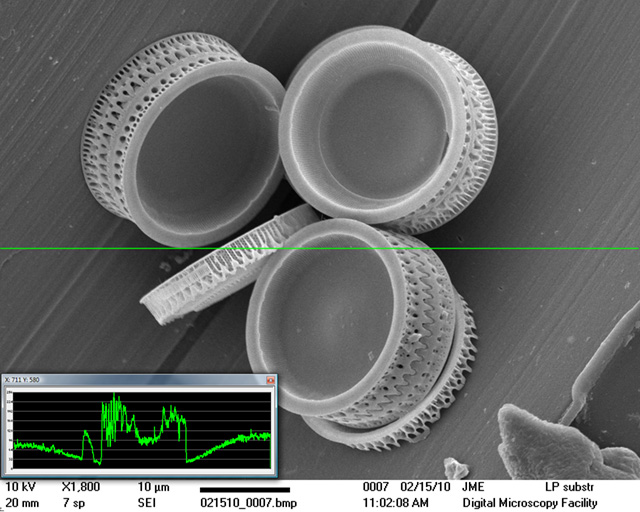
WFM emulates the waveform monitor which was a common tool on analog SEMs for setting brightness and contrast for correct film exposure. With digital microscopes the general feeling seems to be that this step is no longer necessary. This is not really true - it's so much easier to start off with a well exposed digital image than to fuss with it in an image editor. The entire bit-depth of the pixels are utilized in the raw image, eliminating the "picket fence" effect in histograms of post-processed images that indicate loss of information and digital image manipulation, which is often discouraged in scientific journals.

DMF Developed Software: WFM

WFM displays a pixel value profile (from black [0] to white [255]) for the row of image pixels under the mouse cursor (here indicated by the green line). Traversing the whole image vertically while watching the WFM graphical display reveals whether or not the image to be collected utilizes the full range of grey values offered by the collected bit-depth. Generally, the entire line profile is moved up with increasing brightness, while the amplitude of the profile is increased by increasing contrast (although these two are also linked). "Flat troughs" (loss of detail in the dark areas of the image) and "truncated peaks" (loss of detail in the light areas of the image) should be avoided.

WFM can extract information in real-time from a live video signal, provided that the video is not displayed using non-destructive overlays. Unfortunately, the latest image acquisition upgrades for the JSM-5600 use non-destructive overlays, and a workaround has yet to be discovered that doesn't involve purchasing the software developers kit (SDK) from the capture board manufacturer (which is rather expensive). Happily, measurements can still be made on the "Snapshot" frames in the JEOL GUI.